
On this page
What are fascia and soffit, and why do they matter to gutters?
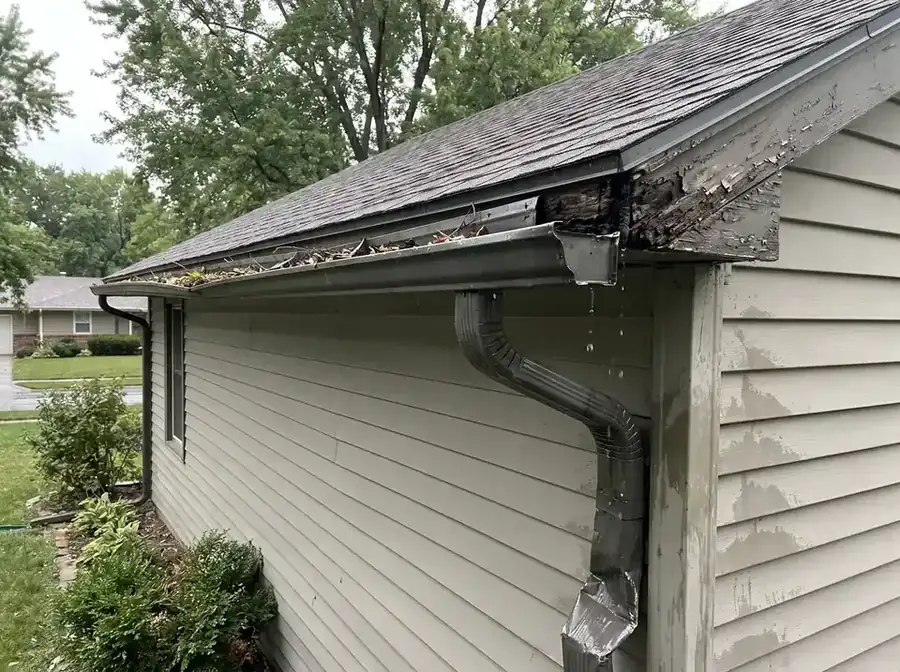
The fascia is the board that closes off the ends of the rafters and carries the gutter. The soffit closes the underside of the overhang and usually holds the vents that let air into the attic. High Desert Seamless Gutters connects callers with independent local gutter contractors, who give the estimates and do the work, and they will tell you the same thing: a gutter is only as secure as the wood behind it.
| Part | Where it is | What it does | How it fails |
|---|---|---|---|
| Fascia | Vertical board at the roof edge | Carries the gutter; closes the rafter ends | Rots from water running behind the gutter |
| Sub-fascia | Framing board behind the fascia on some houses | Structural tie across rafter tails | Rots if the fascia is left wet for years |
| Rafter tail | End of each rafter | Holds the fascia | End-grain rot where the roof edge leaks |
| Soffit | Underside of the overhang | Closes the eave; ventilates the attic | Stains and sags when water backs up at the eave |
| Drip edge | Metal strip under the roofing edge | Guides water into the gutter | Missing or too short on many older roofs |
| Gutter apron | Wider flashing lapping into the gutter | Stops water running down the fascia | Often never fitted |
How does wood rot in a place this dry?
Bend gets only 10.62 inches of precipitation a year. Rot here is not about rain. It is about water held against wood for a long time, and winter does that.
- Snow sits on the roof. Heat from the house melts its underside.
- Meltwater runs to the eave, which is cold, and freezes into a ridge.
- More meltwater pools behind the ridge, finds the edge of the roofing, and runs down the fascia behind the gutter.
- It does this every sunny afternoon for weeks.
- Paint fails, the board stays damp, and decay starts from the back and the top where it cannot be seen.
After the winter of 2016 to 2017 The Bulletin reported that melting ice and snow had sent water through walls and ceilings in Bend homes, damage one resident called an invisible disaster. Fascia and soffit are the first things that water passes.
How is rotten fascia repaired?
- Take down the gutter along the affected eave.
- Find the extent. Rot usually runs further than the visible stain. Probing shows where sound wood begins.
- Cut out the bad section back to the middle of a rafter tail so the new piece has something to fix to.
- Check behind. Rafter tails and sub-fascia are probed and repaired if soft.
- Fit new board. Primed on all sides, including cut ends, before it goes up.
- Flash it. Drip edge and gutter apron go on so water cannot reach the board again.
- Paint, then re-hang the gutter on hidden hangers to a fresh pitch line.
Which fascia materials are used?
| Material | Strengths | Limits |
|---|---|---|
| Primed pine or fir | Matches existing trim; low cost | Needs paint kept up; rots if wetted |
| Cedar | Naturally more decay-resistant | Costs more; still needs sealing |
| Fiber cement | Does not rot or burn | Heavy; needs solid backing for gutter screws |
| Composite or PVC trim | Does not rot | Combustible; moves with temperature |
| Aluminum fascia wrap | Covers and protects wood; no painting | Hides rot if fitted over bad wood |
In wildfire-prone neighborhoods, non-combustible choices such as fiber cement and metal are worth asking about.
What about soffits and vents?
Soffits fail when water backs up at the eave and drips through, or when an ice dam forces water into the overhang. Look for stains, sagging panels and peeling paint under the eave after winter.
Vents matter for two reasons here.
Ice. A cold, well-ventilated attic keeps the roof surface cold, so snow does not melt from below. Blocked soffit vents are one cause of ice dams. See ice dams, snow load and gutters.
Embers. The City of Bend advises covering attic, crawlspace and eave vents with 1/8-inch metal mesh screening, and the Oregon State Fire Marshal gives the same measurement. When soffit work is being done anyway, it is the moment to upgrade the vent screening.
How do I check my own eaves?
- Walk round after a thaw and look for drips from behind the gutter, not just from it.
- Look along the fascia for dark streaks, blistered paint and gaps opening between gutter and board.
- Look up at the soffit for stains and sagging.
- From a ladder on safe footing, press a screwdriver into the fascia below the gutter. Do not do this from a snowy or icy surface.
- Note where icicles form each winter. That eave is where to look first.
What affects the price
Feet of board replaced, how many stories up, whether rafter tails or sub-fascia need work, the material chosen, painting, and whether the gutter is reused or replaced. Carpentry is priced by the foot or by the hour, on top of taking down and re-hanging the gutter. Ask for a per-foot figure in case more rot is found once the gutter is off.