
On this page
- What does a gutter installation include?
- How is a good installation done, step by step?
- What are the parts of a gutter system?
- What do Bend conditions mean for the design?
- What size gutters does a house in Bend need?
- Which metal and shape should I choose?
- What should a written gutter quote include?
- What it costs
- Installation services
What does a gutter installation include?
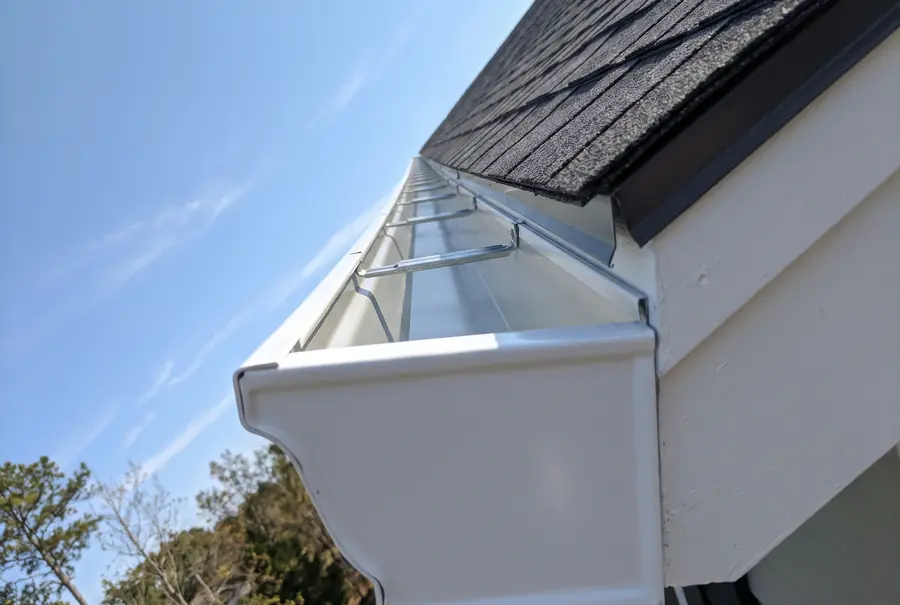
A gutter installation is the whole path water takes from the roof edge to the ground: the trough, its hangers, the outlets, the downspouts and the place each downspout empties. High Desert Seamless Gutters connects callers with independent local gutter contractors, who give the estimates and do the work. A complete job from one of them should cover:
- Measuring. Every eave is measured, and the roof area draining to each one is worked out so the gutter and downspouts are sized to the water, not guessed.
- Fascia check. The board the gutter hangs from is probed for soft wood before anything is fixed to it.
- Forming on site. A truck-mounted machine rolls seamless gutter from coil to the exact length of each run.
- Hanging and pitching. The gutter is set on hidden hangers with a steady fall toward each outlet.
- Downspouts. Downspouts are placed, strapped and aimed somewhere sensible.
- Sealing and testing. Corners, end caps and outlets are sealed, and water is run through the system before the crew leaves.
- Removal. Old gutter is taken down and hauled away if this is a replacement.
How is a good installation done, step by step?
- Walk the roofline. The contractor notes roof pitch, roofing type, valleys, where snow slides and where water can go once it reaches the ground.
- Pick size and metal. Most homes get 5-inch K-style aluminum. Large roofs, valleys and metal roofs point toward 6-inch or steel.
- Deal with the wood. Rotten fascia is replaced. Screws in soft wood will not hold a gutter full of ice.
- Snap the line. A chalk line sets the fall, commonly about a quarter inch for every 10 feet, with long runs pitched from the middle to both ends.
- Set the height. The back of the gutter sits behind the drip edge, and the front lip sits below the plane of the roof so sliding snow passes over it.
- Hang it. Hidden screw-in hangers go into the fascia, into rafter tails where possible, at the spacing agreed in the quote.
- Fit outlets and downspouts. Outlets are cut in, downspouts strapped to the wall, and the bottom fitted with an elbow, extension, splash block or drain connection.
- Seal, test, clean up. Joints are sealed, water is run from the high end, and metal offcuts and screws are picked up with a magnet.
What are the parts of a gutter system?
| Part | What it does | What to ask for in Bend |
|---|---|---|
| Gutter (trough) | Catches water at the eave | Seamless, 0.027 or 0.032-inch aluminum, or steel |
| Hidden hanger | Holds the gutter to the fascia | Screw-in type, every 2 feet or closer |
| End cap | Closes the end of a run | Crimped and sealed inside |
| Miter | Joins two runs at a corner | Hand-cut or box miter, sealed and riveted |
| Outlet (drop) | Lets water into the downspout | One per 30 to 40 feet of gutter at most |
| Downspout | Carries water down the wall | 2x3 for 5-inch gutter, 3x4 for 6-inch |
| Elbow and extension | Turns and carries water away at the bottom | Discharge several feet from the foundation |
| Drip edge or apron | Guides water off the roof into the gutter | Present and lapped over the back of the gutter |
| Snow guard | Holds snow on a metal roof so it melts in place | Fitted above gutters on metal roofs |
What do Bend conditions mean for the design?
Snow is the design load, not rain. Bend averages 10.62 inches of precipitation and 21.6 inches of snow a year. A gutter rarely has to carry much water here, but it regularly has to carry ice. In January 2017 the city took 22.5 inches in four days. The City of Bend notes that snow typically weighs 15 to 20 pounds per square foot at depths like that. Hanger type and spacing matter more than gutter width.
Roofing type changes the plan. Composition shingles hold snow until it melts. Metal roofs release it in one sheet, which can strip a gutter off the wall. On a metal roof the gutter is set low, hung on close centers, and paired with snow guards, or left off the shedding side altogether.
Needles decide the guard question. Under ponderosa pine an open gutter fills fast. If trees stand over the roof, price gutter guards with the installation, when the fit can be planned around the hangers.
Sun and altitude age paint and sealant. Factory-finished aluminum and steel hold up well. Ask what sealant is used at the corners and whether it stays flexible in the cold.
The ground takes water quickly, to a point. The USDA describes the local Deskamp soil series as loamy sand over basalt at 20 to 40 inches, with rapid permeability. Downspouts can often discharge to the surface on a splash block if the grade falls away, but shallow rock limits how much a buried drywell can accept. The downspout drainage guide goes further.
What size gutters does a house in Bend need?
Size follows the roof area draining to each downspout and how steep the roof is. With rainfall this light, a 5-inch K-style gutter with 2x3 downspouts suits most single-story homes. Move to 6-inch with 3x4 downspouts when a large upper roof drains onto a lower one, when two roof planes meet in a valley above the eave, when the run is long and can only have one outlet, or when the roof is metal. The reasoning is set out in 5-inch vs 6-inch gutters and on the 6-inch gutters page.
Which metal and shape should I choose?
| Choice | Strengths | Limits | More |
|---|---|---|---|
| Aluminum K-style | Light, will not rust, widest color range, lowest cost | Dents and can deform under heavy ice | Aluminum gutters |
| Steel K-style | Stiff under snow and ice | Heavier; cut edges must stay coated | Metals compared |
| Copper | Very long life, no paint to fail | Highest cost | Copper gutters |
| Half-round | Suits older and lodge-style homes; sheds debris well | Holds less than K-style of the same width | Half-round gutters |
What should a written gutter quote include?
Ask the contractor to put these on paper so two quotes can be compared line by line:
- Total feet of gutter, and the size and profile
- Metal and thickness, and the color
- Hanger type and spacing
- Number, size and position of downspouts, and where each one discharges
- Corners and how they are made
- Fascia or drip-edge work, priced separately
- Guards or snow guards, if included
- Removal and disposal of the old gutter
- Warranty on materials and on workmanship, and who backs each
- The contractor's CCB license number
What it costs
Published national guides put seamless aluminum at about $9 to $14 a foot installed in 5-inch and $11 to $17 in 6-inch, steel at $12 to $20 and copper at $29 to $40. Those are national ranges, not Bend quotes. Closer hanger spacing, second-story work, steep or metal roofs, fascia repair and guards all move the number. The cost guide has the sources.
Ballpark for your roofline
$1,440 to $2,240
Arithmetic from national price ranges (Angi aluminum gutter cost guide, This Old House seamless gutter cost guide), not a local quote. The number of corners and downspouts, fascia repairs and awkward access all move it. A contractor who has measured your house gives the real figure.
Installation services
- Seamless gutters: formed on site, joints only at corners and ends
- 6-inch gutters: for big roofs, valleys and metal
- Half-round gutters: for older and custom homes
- Copper gutters: soldered, long-lived
- Aluminum gutters: the standard choice
- Downspouts: sizing, placement and discharge