
On this page
- The short answer
- What can I check from the ground?
- Which way does each sign point?
- Why does ice damage usually mean replace, at least in part?
- How does the money work out?
- When is replacement clearly the better buy?
- And when is repair clearly enough?
- What do different gutter ages usually look like?
- What will a contractor check that I cannot?
- The bottom line
The short answer
Repair when the metal is sound and the fault is local. Replace when the metal itself is damaged, when faults are everywhere, or when the system was never right for the roof. High Desert Seamless Gutters connects callers with independent local gutter contractors, who give the estimates and do the work, and a contractor on site can settle it in a few minutes.
What can I check from the ground?
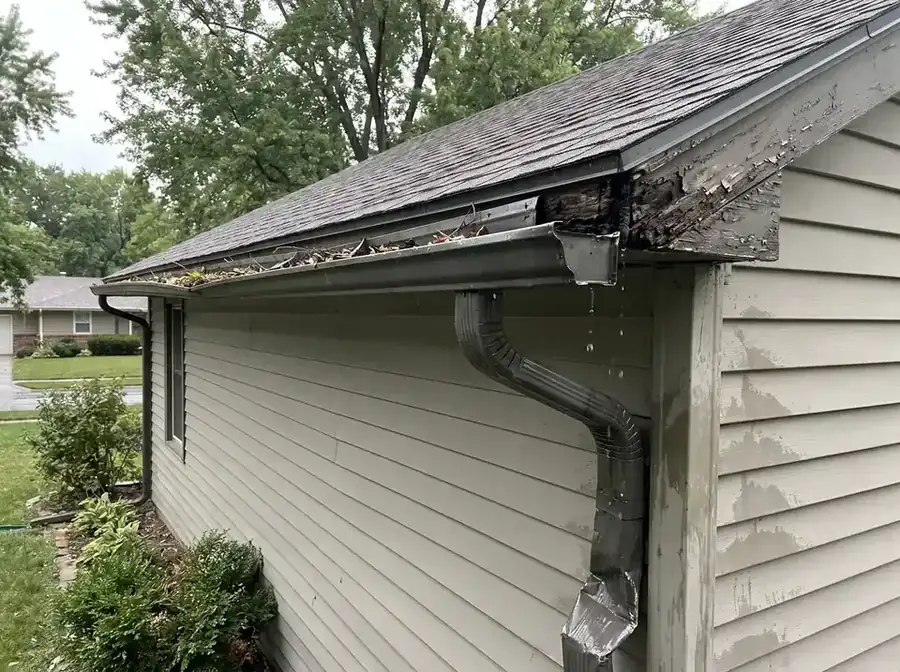
- Sight along each run. A straight line that dips is a hanging problem. A kink or twist is metal damage.
- Look at the front lip. Rolled outward means snow has opened the profile.
- Look for gaps between the gutter and the fascia.
- Look at spike heads. Standing proud means they are backing out.
- Look for stains on the fascia and soffit below joints.
- Count the patches. Blobs of old sealant in many places tell a story.
- Watch it work. In rain or a thaw, see where water overflows, drips or stands.
- Check the ground below downspouts for washouts and ice.
Which way does each sign point?
| Sign | Repair | Replace |
|---|---|---|
| One corner dripping | Yes | |
| Spikes backing out, metal straight | Yes: add hidden hangers | |
| Standing water, metal straight | Yes: re-pitch | |
| One downspout split or crushed | Yes | |
| Crease or kink in a run | That run | |
| Front lip rolled along the eave | That run, hung lower | |
| Seams leaking every 10 feet | Whole system, with seamless | |
| Rust-through or pinholes | Yes | |
| Faults on most sides of the house | Yes | |
| Overflow even when clean | Yes: larger size or more outlets | |
| Fascia rotten along most of an eave | Usually, with the wood | |
| Vinyl gutter, brittle or sagging | Yes, with metal |
Why does ice damage usually mean replace, at least in part?
Ice and sliding snow do two different things. They pull fasteners out, which is repairable, and they bend metal, which is not. After winters like 2016 to 2017, many gutters in Bend had both. The test is the profile: if the gutter still has its factory shape once it is lifted back into place, it can be re-hung. If the front has opened out or the floor has creased, that run is finished.
There is a second point. A gutter that was torn off was hung in a way that could not carry the load. Putting it back the same way guarantees a repeat. Whether repairing or replacing, change the method: hidden hangers at 2 feet or closer, front lip below the roof plane, snow guards on metal roofs. See ice and snow damage.
How does the money work out?
| Approach | First cost | What you get | Risk |
|---|---|---|---|
| Spot repair | Low | Problem fixed where it showed | Other weak points fail next winter |
| Full re-hang on new hangers | Moderate | Old metal, new fastening and pitch | Old sealant at joints still ages |
| Replace one eave | Moderate | New run where damage was | Color mismatch for a time |
| Replace everything | Highest | New metal, hangers, flashing, sized correctly | None beyond normal wear |
Published national guides put new 5-inch seamless aluminum at about $9 to $14 a foot installed. Compare that against repair quotes over the next few years, not just this one.
When is replacement clearly the better buy?
- You are re-roofing. The edge is open and scaffolding or lifts are on site.
- The gutters are sectional or vinyl.
- You want guards. Fit them to new gutter, not to a system near its end.
- The house is being painted or sold and the gutters are visibly tired.
- The gutters are the wrong size and overflow when clean.
And when is repair clearly enough?
- The system is seamless, heavy-gauge and under 15 years old.
- One event caused one failure.
- The fascia is sound.
- The problem is a downspout or a joint.
What do different gutter ages usually look like?
| Gutter | Typical condition | Usual advice |
|---|---|---|
| Under 10 years, seamless aluminum | Sound metal; hangers may be too far apart | Add hangers; repair as needed |
| 10 to 20 years, seamless aluminum | Sealant aging at corners; some sag | Reseal, re-hang; replace bent runs |
| Over 20 years, seamless aluminum | Paint chalked; joints tired | Decide run by run |
| Sectional aluminum, any age over 10 | Seams leaking | Replace with seamless |
| Vinyl | Brittle, sagging, combustible | Replace with metal |
| Steel with rust showing | Coating failed | Replace |
| Copper | Usually sound for decades | Repair; resolder joints |
What will a contractor check that I cannot?
- Fascia behind the gutter, by probing along its length.
- Pitch, with a level or by running water.
- Hanger type and spacing from above.
- Drip edge and apron, to see whether water is getting behind.
- Inside of corners and end caps, where sealant fails first.
- Downspout interiors and any buried drains.
Ask for the findings in writing, with photos, and for both a repair price and a replacement price where the case is not clear-cut. High Desert Seamless Gutters connects callers with independent local gutter contractors, who give the estimates and do the work.
The bottom line
Judge the metal, not the age. Straight and sound: repair, and upgrade the hangers. Bent, holed or failing everywhere: replace.